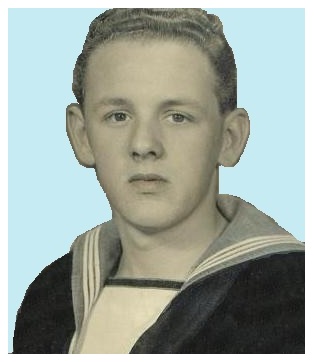
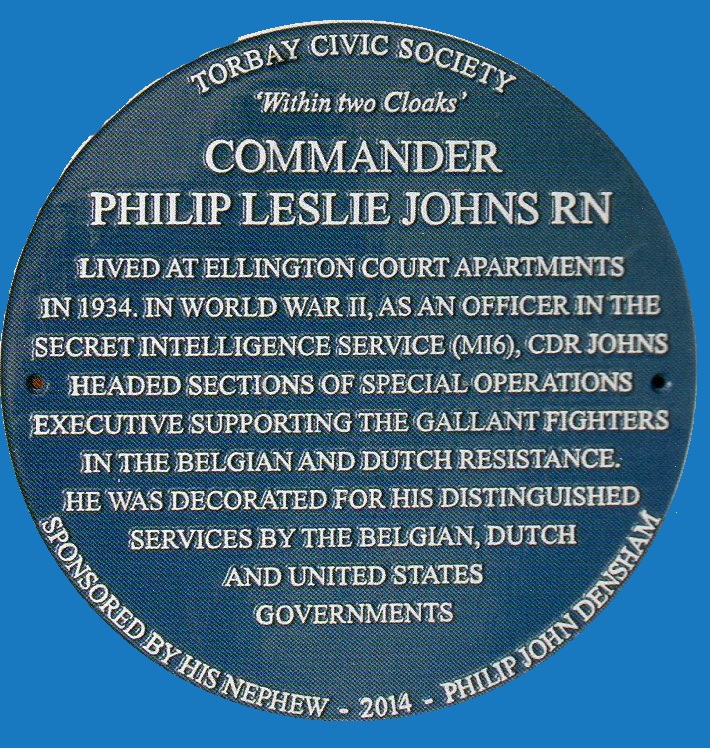
|
New Blue Plaque has been unveiled in
Torquay to honour a WWII secret service hero
|
Commander Philip Leslie Johns RN, who played
a prominent role in both the SOE and SIS (Later MI6)
against Nazism in WW2. |
|
 |
He was born 18 Jan 1900 in Exeter and
lived at Ebrington Terrace,
St Thomas. His parents were
Philip Charles (clerk and later a director in Tremletts
Tannery at Exeter) and Mary Mabel Johns. Philip, known in
the Coldridge family as Leslie, had joined the Royal Navy on
17 July 1917 aged 17 and at his own request would retire as
a Paymaster Lieutenant in 1922. In 1923 at St Jude’s church,
Kensington, he married Amelia (known as Millie) Sarah
Coldridge of Teignmouth. After only 5 years of marriage they
separated in 1928 and later were divorced in 1931. Later he
married Canadian born Dorothy Elliott in Paris and they had
two children Angela and Michael both born in Torquay.
5 years after Dorothy’s death in 1962 Philip would
marry again, to Sussex born Veronica Anderson in San
Francisco, and she died in Alicante, Spain in 1976. He died
on 9 Mar 1993 in Hillsborough, Florida, USA. |
|
The
Special Operations Executive (SOE), in which Philip was to
play a significant covert role, had been formed in mid-1940,
a secret organisation concerned with espionage, sabotage,
etc. in Axis dominated countries. Prime Minister Churchill
had ordered the SOE to “set Europe ablaze” and this newly
formed group was regarded by SIS colleagues as something of
a troublesome upstart. The organisation was disbanded in
early 1946. The Secret Intelligence Service formed in 1909
became the organisation for foreign intelligence gathering
activities and later
was to be
known as MI6. Its function continues to gather foreign
intelligence.
Philip’s fascinating published memoir “Within Two Cloaks:
Missions with SIS and SOE” recounts how his intelligence
mission started in April 1939. While serving in Naval
Control Operations in Antwerp, Philip was recruited by a
civilian from the Passport Control Office (i.e. British
Secret Intelligence) of the British Embassy in Brussels in
neutral Belgium.
Shortly after
September, Philip became an officer in Military Intelligence
6 (MI6) Secret Intelligence Service (SIS). He was to retain
his cover as a Naval Control officer while maintaining a
watch on known German agents and any contacts with the
Belgian pro-Nazi party. He built up a clandestine network
for coastal and port watching covering enemy shipping
movements and especially submarines operating in the North
Sea and North Atlantic. Through close friendly contact with
the Head of Police Judicaire in Antwerp - responsible for
registration and issue of identity papers - many suspected
agents of the German SD (Sicherheitsdienst) and
collaborators were identified. In 1939-40 he set up sleeper
agents to provide intelligence by radio if and when Belgium
was invaded which soon after, it was. In early 1941 Philip
took over as Head of Station, Lisbon for 2 years, followed
by a spell in Argentina. On being recalled to London he was
appointed Head of the Belgian and Dutch Sections of SOE
during the final 18 months of the war. In this period he
served in those countries arranging the supply of arms and
materials to the various Resistance groups for sabotage and
harassment of the Nazi enemy and for the final armed rising
of the underground units. In his memoir he comments and
seeks to do justice, to the courageous exploits of the
thousands of men and women of these two countries which have
been much overlooked in English books published since.
Philip's WW2 RN service record reads: |
|
1939-1940 |
served with
MI6 [the (SIS)] in the Brussels Station Belgium) |
|
19.05.1940
(02.)1941 |
Naval
Intelligence Division, Admiralty [HMS President: a stone
frigate] (serving in Section III (Naval) of the SIS) |
|
(04.1941)
(07.1945) |
Naval
Intelligence Division, Admiralty [HMS President] * (serving
from the spring of 1941 with MI6 (SIS) as Head of Station in
Lisbon, Portugal |
|
Dec. 1942
|
As Head of
Station in Buenos Aires, Argentina, and from late 1943 in
charge of Dutch & Belgian sections of the SOE |
|
Nov. 1943 |
New York, USA
Head of Belgian Section SOE |
|
1943
|
Rio de
Janeiro, Brazil Head of Station |
|
July 1945 |
He retired
with the rank of Acting Commander (S). |
|
In recognition
of his services in World War 1 Philip was awarded the
British War Medal
and
Victory Cross in 1919.
Then after World War 2, in 1946 he was
awarded the Officer Order of
Orange-Nassau (for services
to the Netherlands); and in 1947 was awarded the Legion
of Merit (USA).
In 1948 he was awarded the
Croix de Guerre (Belgium)
the latter being re-established in 1940 by the Belgian
Government in exile in London in recognition of bravery and
military virtue during WW2. The Order of the Crown was
bestowed to military and diplomatic personnel of other
countries stationed in (or providing support to) Belgium,
and were bestowed on him by HRH Charles, the Prince Regent.
During World War 2, the Order of the Crown was extensively
authorized for award to Allied military personnel who had
helped to liberate Belgium from the occupation forces of
Nazi Germany. Finally, he was further honoured
when it was gazetted by order of King
George VI that he may wear all his foreign decorations on
all occasions when in uniform. |
 |
|
Philip and his
first wife Millie started their early married life in
Antwerp, Belgium. His cover was as London company director
of the Fisk Tire Export Company (New York) (1923- 1945),
manufacturers of automobile tyres.
Millie, who
died in 1972, never knew anything of his undercover
activities but was reportedly suspicious when she became
aware that he was meeting a number of 'strange people'. This
led to the subsequent breakdown of their marriage resulting
in divorce.
Philip's second child Michael Philip
(1934-2009) from his second marriage was born at the then
next door Mount Stuart Maternity Home
*
on St Lukes Road South, while the family was residing at
Ellington Court apartments in St Luke's Rd South, Torquay,
Devon
With war
imminent, and at age 4 years, Michael was sent to the USA to
stay with the Fenton family with whom his father Philip was
well acquainted through the Fisk Tire company, of which Mr
Fenton was President. David, the Fenton's son and Michael
Johns became very close friends. Michael's older sister
Angela (born January 1933) at Mount Stuart, went to Canada
together with her mother Dorothy where they lived with
Dorothy's sister. |
Return to RNA Torbay Home
Page
This
page last updated on November 12th, 2014
|
 Site Directory |